


TA QUANT WEEKLY MARKET INSIGHTS
April 13-19, 2026
MARKET SNAPSHOT
| Asset | Price | Weekly Change | Sentiment |
|---|---|---|---|
| BTC | ~$72,800 | +5.6% | Extreme Fear |
| ETH | ~$2,237 | +5.2% | Extreme Fear |
| Gold | ~$4,780 | +2.0% | Cautious Bid |
| Brent Crude | ~$101.80 | +7.9% | Geopolitical Premium |
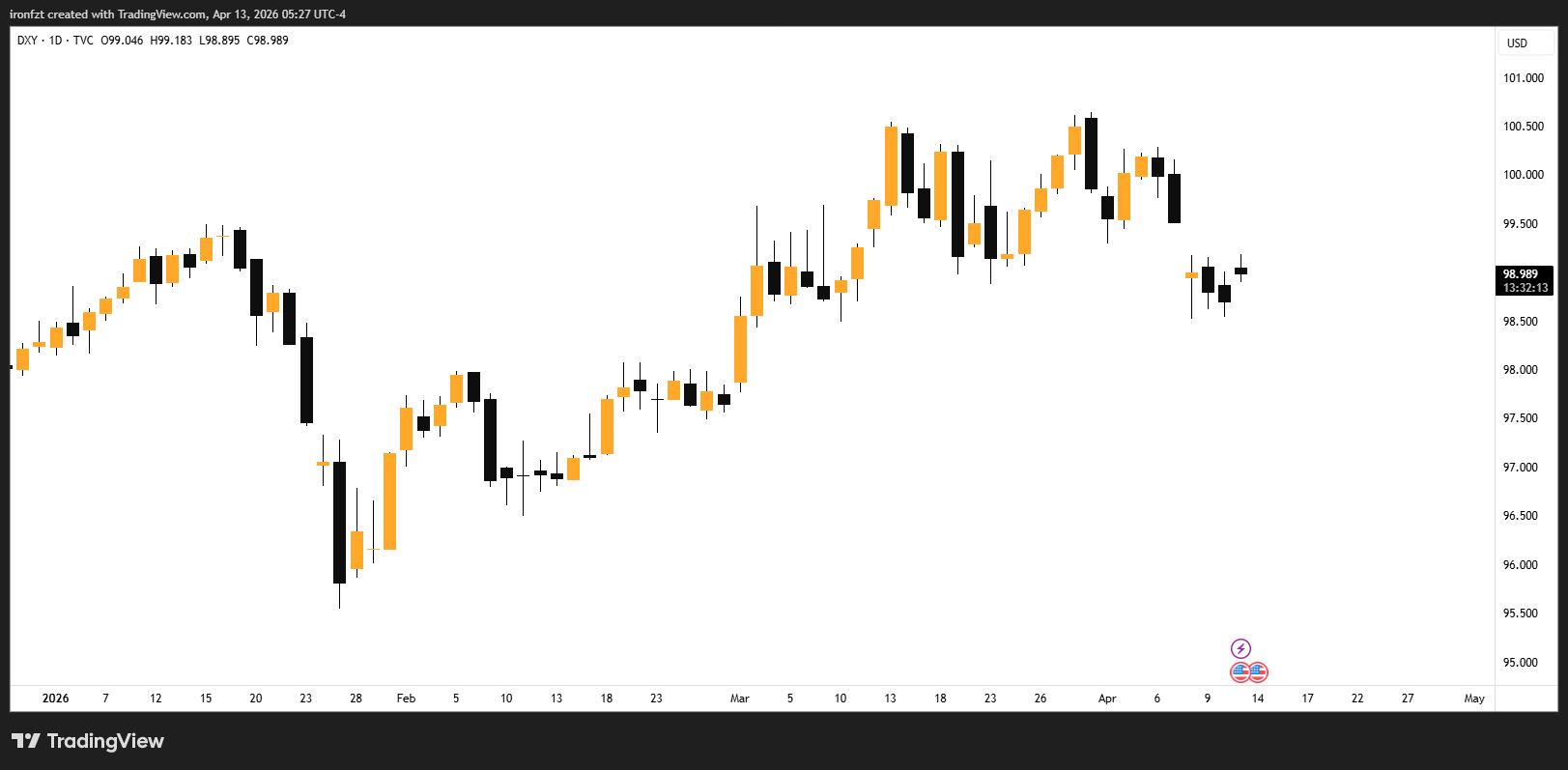
| DXY | ~99.0 | Reclaiming 99 | Safe-Haven Bid |
MACRO + GEOPOLITICAL OVERVIEW
The Hormuz Crisis: Where Things Stand Right Now
This week marks a significant escalation in the US-Iran conflict that has dominated global markets since late February. The war, which began when the US and Israel launched coordinated airstrikes on February 28 under Operation Epic Fury, entered a critical new phase over the weekend.
Peace talks held in Islamabad, Pakistan broke down after 21 hours of negotiations on April 12. The US delegation, led by Vice President JD Vance, accused Tehran of refusing to halt its nuclear program. Iran, for its part, demanded ongoing control of the Strait of Hormuz, payment of war reparations, a broader regional ceasefire (including Lebanon), and the release of frozen overseas assets. Neither side blinked.
Following the collapse of talks, President Trump announced a US naval blockade of the Strait of Hormuz, effective Monday April 13 at 10am ET. CENTCOM clarified the blockade targets vessels entering and exiting Iranian ports specifically, and will not impede ships transiting to non-Iranian ports. Iran's IRGC immediately issued warnings that military vessels approaching the strait would be treated as ceasefire violations.
The practical impact is severe. The Strait of Hormuz has been largely closed since February 28, disrupting roughly one-fifth of the world's seaborne oil trade. Saudi Arabia reported attacks on its oil facilities have reduced production capacity by around 600,000 bpd. The Asian Development Bank warned the prolonged conflict is the single biggest risk to the Asia-Pacific growth outlook, projecting regional inflation rising to 3.6% in 2026.
Inflation Shock Arrives in US Data
The first US CPI report since the war began confirmed what markets already feared. Consumer prices rose 0.9% in March, the steepest monthly jump since June 2022, pushing the annual rate to 3.3%, up sharply from 2.4% in February. Core CPI was more modest at 2.6%, suggesting the full oil shock has yet to fully transmit through the broader economy, but the direction is clear.
The Federal Reserve is effectively boxed in. Markets now see essentially zero chance of a rate cut before late 2026, with just a 30% probability of one cut by December. Fed officials are watching energy prices as the primary variable. The longer Hormuz remains closed, the harder the inflation problem gets and the tighter the Fed's hands become. This is the core macro pressure bearing down on risk assets right now.
Dollar and Global FX
The DXY recovered back above 99 on Monday after dipping below that level during last week's brief ceasefire-driven relief rally. The dollar has functioned as the primary safe-haven of this crisis, more so than traditional alternatives like the franc or yen, as energy inflation risk is perceived as harder on Europe and Asia than the US. The 52-week range for DXY sits between roughly 95.36 and 101.82, with the current level reflecting ongoing tension between crisis safe-haven demand and longer-term concerns about US fiscal trajectory.
CRYPTO: BTC + ETH
Bitcoin
BTC has spent the past two months range-bound between $62,000 and $75,000, with the current price sitting around $72,800. Sentiment remains deep in Extreme Fear territory despite recent price gains, a reflection of how macro forces are overwhelming any organic crypto momentum.
The pattern is notable. A similar two-month consolidation played out between November 2025 and January 2026 before a breakdown, and analysts are flagging the structural similarity. Key levels to watch are $75,000 on the upside and $65,000 as the structural floor. A break of $65k would be significant and likely coincide with broader macro deterioration.
On the positive side, TD Cowen published a note maintaining a $140,000 BTC price target by late 2026, citing its digital gold narrative and BTC's evolving role as a strategic reserve asset. Institutional integration via spot ETFs continues, and Bitget Research noted that short-term capital rotation is increasingly shaped by macro signals rather than crypto-native catalysts. Derivatives data shows open interest up about 4% weekly but funding rates marginally negative, suggesting controlled accumulation rather than aggressive leverage buildup.
Ethereum
ETH is sitting around $2,237, recovering from its early-April lows near $2,058 but still well below the $3,000+ levels that would signal a genuine trend shift. BTC dominance is holding above 57%, which historically has capped altcoin outperformance.
The thesis for ETH in 2026 remains tied to Layer-2 growth, DeFi stabilization, and whether institutional engagement accelerates. Fundstrat's Tom Lee has argued for a strong ETH cycle, with mid-to-high four-figure targets if adoption trends hold. On-chain activity remains the critical variable. For now, ETH is tracking macro conditions more than its own fundamentals.
Notable protocol news: Aave passed a landmark governance vote directing 100% of application and product revenue back to AAVE token holders, resolving a months-long dispute over fee routing. Separately, Seamless Protocol began shutting down and Fantom Opera is set to close June 30 as it completes migration to Sonic infrastructure, reflecting continued ecosystem consolidation.
GOLD (XAU/USD)
Gold is trading around $4,780, recovering toward its mid-March highs after a sharp drawdown caused by the initial oil shock. Since the war began, gold has lost over 11% from pre-conflict levels as surging oil prices damped expectations for US rate cuts, creating an unusual macro environment where the traditional safe-haven trade underperformed the dollar.
The dynamic is starting to reverse. The two-week ceasefire, even though it has now effectively collapsed, triggered a 2% weekly gain for gold as markets priced in earlier rate cuts. Gold has posted three consecutive weeks of gains, driven by a weaker dollar during the ceasefire window and growing concerns about inflation's durability.
State Street's monthly gold monitor frames the current period as 'down but not out,' maintaining a base case range of $4,750-$5,500/oz into year-end. JPMorgan and Goldman Sachs have projected a range of $4,000-$6,300 for 2026. China remains a key structural buyer, with the PBOC at an all-time high of approximately 2,309 tonnes in official reserves.
For gold to push materially higher, the market likely needs either a deal-driven rate cut repricing or a further escalation that forces flight-to-safety across all assets. A formal peace deal, if it ever materializes, could trigger a sharp gold selloff as oil prices fall and rate cut expectations get pushed back out. That is the key near-term risk to gold longs.
ALTCOIN LANDSCAPE
The altcoin market has shown interesting divergence this week. Rather than the unified beta movements of previous cycles, specific sectors are outperforming while others continue to bleed. This suggests a maturing market where capital is rotating based on perceived utility rather than hype.
AI and compute tokens (FET, RENDER) have held up relatively well, as have privacy tokens (ZEC, DASH), with DASH posting a 22%+ gain on the week. The CoinDesk Computing Select Index has outperformed the broader CD20 benchmark. In contrast, many DeFi and Layer-1 tokens remain under heavy pressure, with assets like ENA, TIA, LDO, SUI, and ARB all down 50%+ over the past 90 days.
OUTLOOK + WHAT TO WATCH
The key variable for all markets in the week ahead is the Hormuz situation. The blockade has now officially begun, and the range of outcomes from here is wide. De-escalation toward a ceasefire or deal would likely trigger a sharp relief rally across crypto and equities, a gold selloff, and an oil price drop. Escalation, including potential military strikes, would do the opposite across the board.
Vance left Islamabad saying diplomacy is not over, and that the US has a 'final and best offer' on the table. Iran's position remains focused on nuclear rights and Hormuz control as non-negotiables. The gap is significant, but both sides are clearly still talking. Markets will trade every headline.
Calendar: Key Events This Week
-
April 14: US PPI data (March) - first major follow-up to the 3.3% CPI print
-
April 15: Federal Reserve Beige Book release
-
April 13 onward: Hormuz blockade enforcement begins, watch for any incidents
-
Ongoing: US-Iran diplomatic back-channel activity - any resumption of talks is the biggest potential catalyst