


TA QUANT WEEKLY MARKET INSIGHTS
MARKET SNAPSHOT
| Asset | Price | Weekly Change | Sentiment |
|---|---|---|---|
| BTC | ~$75,800 | +4.1% (wk) | Fear (improving) |
| ETH | ~$2,310 | +3.2% (wk) | Fear |
| SOL | ~$85.50 | Flat | Neutral |
| Gold (XAU) | ~$4,700 | -1.6% (wk) | Cautious |
| Brent Crude | ~$94-96/bbl | Volatile | Geopolitical |
| DXY | ~98.5 | Retreating | Mixed |
MACRO + GEOPOLITICAL: CEASEFIRE ON THE EDGE
The War This Week: Ceasefire Extended, Talks Uncertain
The defining macro event of the week is the fragile extension of the US-Iran ceasefire, announced by President Trump on April 21. The two-week truce, which was set to expire Wednesday, has been extended indefinitely, but only until Iran submits a unified negotiating proposal. The naval blockade of Iranian ports remains in full force.
The week opened with serious escalation. Over the weekend, the US Navy seized an Iranian-flagged cargo vessel near the Strait of Hormuz after it ignored warnings. Tehran retaliated by targeting ships in the strait and reasserting control over the waterway, directly accusing the US of ceasefire violations. Iran's Foreign Minister Abbas Araghchi called the US blockade of Iranian ports an 'act of war.' Oil surged more than 5% at Monday's open in response.
By Tuesday, reports emerged that Iran may be willing to send a delegation to a second round of talks in Islamabad, reversing earlier signals it would not attend. This partial thaw pulled Brent crude back below $95. Trump said he was 'optimistic' about a deal but simultaneously warned he was ready to resume bombing if talks collapse, and insisted the Strait of Hormuz would remain blocked until a comprehensive agreement is signed.
Trump on April 21: 'We're going to end up with a great deal.' On the same day, he said he was ready to resume bombing if talks don't go well. Both statements are true and equally priced in by markets.
The core sticking points remain unchanged: Iran demands control of the Strait of Hormuz, war reparations, continuation of its nuclear program, and a broader regional ceasefire including Lebanon. The US demands no nuclear enrichment, full reopening of the Strait, and has made clear it will not lift the naval blockade until a deal is finalized. There is no overlap between those positions yet.
The human cost of the conflict continues to grow. Iran's forensics chief reported nearly 3,400 deaths inside Iran since strikes began on February 28. More than 2,200 have been killed in Lebanon and 32 in Gulf states. The death toll is increasingly becoming a factor in domestic Iranian politics and in the international pressure on both sides to reach a resolution.
The Fed Chair Question: Warsh Moves to Center Stage
The second major macro story of the week is Kevin Warsh's Senate Banking Committee confirmation hearing on April 21. Warsh, Trump's nominee to succeed Jerome Powell when his term expires May 15, represents a meaningful policy inflection point, particularly for crypto markets.
Warsh's financial disclosures revealed over $100 million in crypto-related investments across more than 20 projects, including Bitwise Asset Management, Solana, dYdX, Polymarket, and Bitcoin Lightning infrastructure firm Flashnet. He would be the first Fed Chair nominee in history with meaningful direct exposure to digital assets. He would need to divest those positions under Fed ethics rules if confirmed.
At the hearing, Warsh emphasized Federal Reserve independence, pushing back on Trump's repeated public calls for immediate rate cuts. 'The President never asked me to commit to any particular interest rate decision, and nor would I ever agree to do so,' he said before the committee. Trump, in a CNBC interview the same day, said he would be disappointed if Warsh doesn't cut rates immediately, creating a visible public tension.
For markets, the nuance matters. Warsh has historically been viewed as an inflation hawk, opposing rate cuts and quantitative easing after the 2008 crisis. But he has also argued that the Fed has too often been slow to respond to changing conditions. With inflation running at 3.3% annual and oil prices elevated by the war, the policy path is genuinely unclear. Markets currently price in effectively zero chance of a rate cut before late 2026, with only a 30% probability of one cut by December. A Warsh-led Fed that treats energy-driven inflation as transitory could shift that pricing significantly.
CRYPTO: BTC + ETH
Bitcoin: Breaking Out of the Range
BTC has pushed above the $75,000 level that analysts flagged last week as the make-or-break threshold for bulls. The asset briefly touched $76,535 Tuesday morning before pulling back as Warsh's hearing unfolded and Iran talk uncertainty resurfaced. The weekly picture looks constructive, with BTC up roughly 4% from last week's close around $72,800.
Crucially, this is the first sustained hold above $75,000 since the war-driven selloff in late February. The two-month range between $62k and $75k appears to be resolving to the upside, supported by a clear uptick in institutional flows. Spot BTC ETFs have added over $1.6 billion this month, with cumulative net inflows now at $57 billion. Strategy (formerly MicroStrategy) added 13,927 BTC to its holdings, bringing total holdings to approximately 780,897 BTC, or roughly 3.8% of all circulating supply.
Technically, BTC has formed an ascending triangle pattern on shorter timeframes. The Supertrend indicator has flipped bullish, RSI is rising, and the $75,000 level is now acting as support. The next meaningful resistance cluster sits at $88,000-$93,000 (the 50% Fibonacci retracement of the macro move). A confirmed weekly close above $76,000 would be the cleanest technical confirmation of a regime shift.
BTC Key Levels
Support: $75,000 / $72,000 | Resistance: $80,000 / $88,000 / $93,300 | Invalidation: Weekly close below $72,000
Ethereum
ETH is trading around $2,310, up modestly on the week. The bigger story for ETH is the institutional flow narrative. Spot Ethereum ETFs recorded $328 million in weekly inflows, the best week since January, with BlackRock's ETHA and Fidelity's FETH leading. Year-to-date ETH ETF net inflows have now crossed $197 million. This is still relatively modest compared to BTC ETF flows, but the direction is clear.
On-chain, the DeFi space had a rough week. KelpDAO suffered a significant exploit over the weekend that hit Aave's ecosystem and caused AAVE token to fall sharply. Aave's core lending markets briefly hit 100% utilization, raising concerns about protocol solvency. CertiK flagged the situation as serious, while Aave CEO Stani Kulechov offered limited public commentary. The event is a reminder that DeFi remains high-risk even as institutional adoption accelerates.
ETH Key Levels
Support: $2,200 / $2,050 | Resistance: $2,500 / $2,800 | Watch: Reclaiming $2,500 is the next meaningful structural target
Altcoin Flows
The altcoin picture remains mixed but showing early signs of broadening. XLM and TON posted gains above 5% in the past 24 hours, and the CoinDesk Memecoin Index is up over 3% on the week. The DeFi Select Index added 2% despite the KelpDAO/Aave situation, suggesting selective rotation rather than a sector-wide move.
Worth noting: XRP-related products saw $56 million in outflows last week, and SOL products lost $2.3 million, suggesting institutional capital is consolidating into BTC and ETH rather than spreading across the altcoin stack. BTC dominance remains above 57%. A sustained drop in dominance would be the cleaner signal that the altseason rotation is underway.
GOLD (XAU/USD)
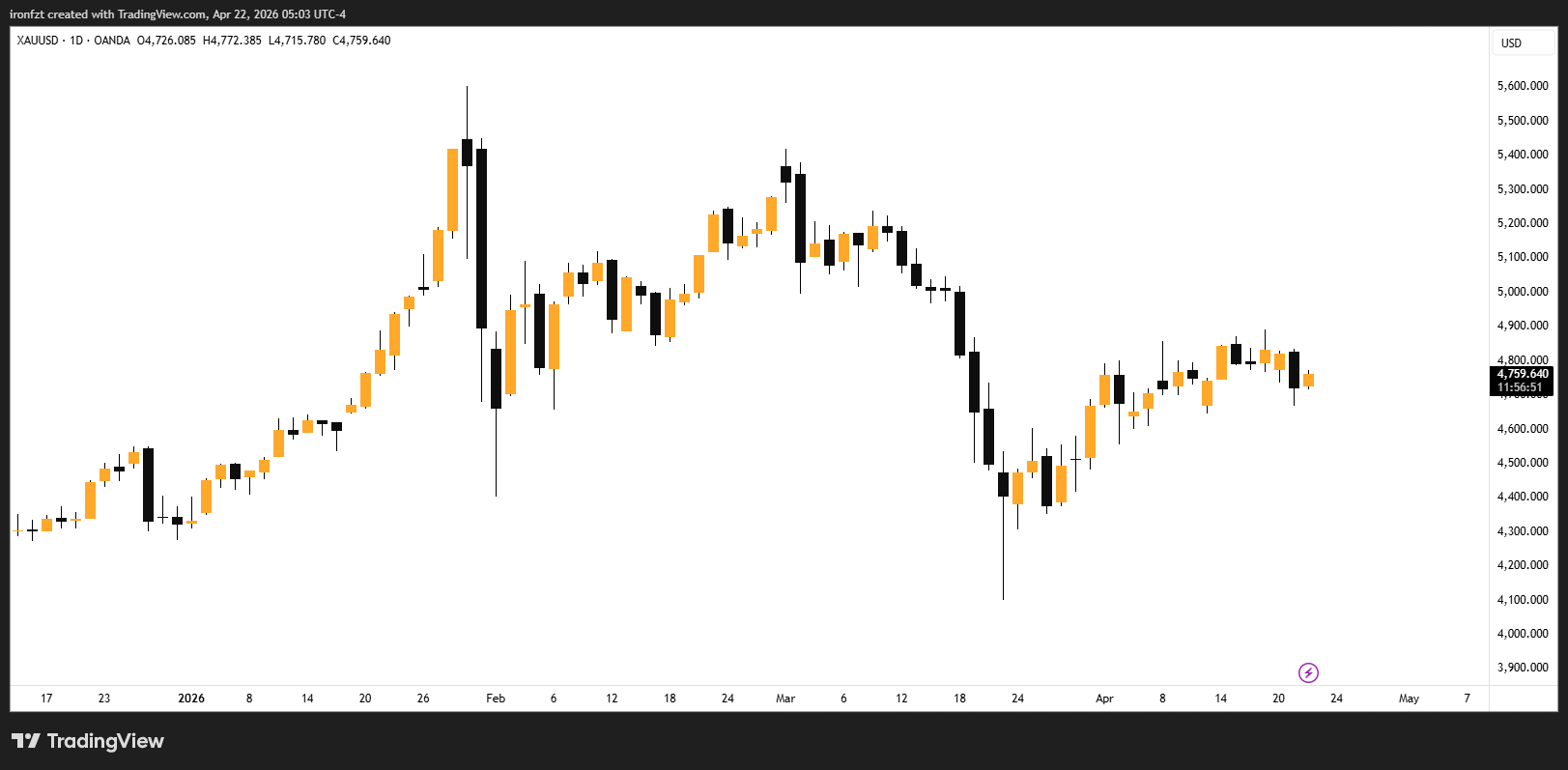
Gold has given back some of last week's gains, trading around $4,700 after briefly touching $4,850 on Friday following news that the Israel-Lebanon ceasefire corridor would remain open. The metal dropped as much as 2% on Monday as oil spiked on renewed Hormuz tensions and the US ship seizure, reigniting inflation concerns that weigh on rate cut expectations, which in turn weigh on non-yielding assets like gold.
Gold is now down roughly 8-10% since the war began on February 28, which feels counterintuitive for a traditional safe-haven. The dynamic reflects the unusual nature of this crisis: oil-driven inflation reduces the probability of rate cuts, and the dollar has absorbed the majority of safe-haven flows. That said, with the ceasefire extended and talk of a possible deal still alive, any meaningful de-escalation that brings oil prices lower could quickly reprice rate cut expectations and create a strong tailwind for gold.
The World Gold Council's technical model shows the DXY being capped at key resistance around 100.26-101.14 (the 38.2% retracement level of the 2025-2026 fall). As long as DXY stays below that zone, gold has structural support. The medium-term range remains constructive, with JPMorgan and Goldman maintaining $4,000-$6,300 as the 2026 band. Physical demand from China and central bank accumulation continues to provide a structural floor.
TA Quant Positioning View
The macro backdrop is shifting incrementally toward risk-on, but conviction remains low until the Hormuz situation resolves. BTC breaking and holding above $75,000 is the single clearest signal in the market right now. ETF inflows confirm institutional demand. The Warsh nomination, if confirmed, is a medium-term positive for crypto given his digital asset familiarity, though his inflation hawkishness is the near-term governor.
For market makers and algo strategies, the current environment rewards reactivity over positioning. Vol is elevated across oil and crypto, spread opportunities remain wide, and the headline-driven price action creates systematic opportunities for strategies designed to capture dislocations. The next clean directional signal will likely come from whichever way the Iran talks break.