


On-Chain Implementation Specification
Smart Contract Architecture, EVM Integration, and ZK-Rollup Infrastructure
TYLER LEONARD
**TAQUANT RESEARCH LABS **
January 2026
Abstract
This technical specification provides comprehensive implementation details for deploying Proof-of-Behavior (PoB) consensus mechanisms on existing blockchain infrastructure. Building upon our foundational research establishing PoB’s theoretical framework and empirical performance (including >90% fraud detection improvement and the Trade-Aware Quantizer (TAQ) foundation model).
We focus on two critical implementation pathways:
- EVM-compatible smart contract architectures enabling PoB deployment on Ethereum, Polygon, Arbitrum, and other EVM chains.
- ZK-rollup integration leveraging zero-knowledge proofs for scalable, privacy-preserving behavioral verification.
For each pathway, we provide detailed contract interfaces, system architecture diagrams, workflow specifications, and integration patterns.
The modular architecture presented enables incremental adoption without requiring complete network overhauls. Protocols can begin with simple EVM contract integration for behavioral scoring, then progressively add ZK verification for enhanced scalability and privacy. Our specifications achieve behavioral fidelity of 85-95% on EVM deployments and 80-90% on ZK-rollup integrations relative to native PoB implementations, while maintaining compatibility with existing DeFi infrastructure.
1. Introduction
1.1 Document Purpose and Scope
This document serves as the definitive technical specification for implementing Proof-of-Behavior consensus mechanisms on existing blockchain infrastructure. While our foundational research established the theoretical framework and demonstrated empirical performance improvements, this specification provides the engineering blueprints necessary for production deployment on EVM-compatible chains and ZK-rollup systems.
The implementation pathways presented here address the practical challenges of integrating behavioral inference into existing blockchain infrastructure, recognizing that most deployments will occur on established networks rather than purpose-built chains. We therefore prioritize compatibility, modularity, and incremental adoption strategies.
1.2 Relationship to Foundational Research
This specification extends three interconnected frameworks established in our foundational research:
- Proof-of-Behavior (PoB): A consensus mechanism that quantifies and rewards validators’ verifiable behaviors, creating self-regulating systems aligned with network security and fairness.
- Behavioral State Inference: A framework modeling market participants as adaptive agents whose latent behavioral states evolve over time and manifest through execution-level actions.
- Trade-Aware Quantizer (TAQ): A tokenizer-based foundation model pretrained on approximately 503,000 time series from diverse trade execution datasets, producing high-quality behavioral embeddings for downstream market design tasks.
Together, these components enable behavior-driven financial systems where behavioral inference serves as a transparent, on-chain computable signal for adaptive market mechanisms, validator selection, and incentive distribution.
1.3 Implementation Hierarchy
| Integration Level | Behavioral Fidelity | Complexity | This Document |
|---|---|---|---|
| EVM Smart Contracts | High (85-95%) | Medium | Section 3-4 |
| ZK-Rollup Integration | High (80-90%) | Medium-High | Section 5-6 |
EVM smart contracts provide the most accessible entry point, enabling behavioral scoring on any EVM-compatible chain with moderate development effort. ZK-rollup integration adds privacy-preserving verification and enhanced scalability, suitable for high-throughput applications requiring confidential behavioral inference.
2. Proof-of-Behavior: Core Concepts and Empirical Foundation
2.1 Fundamental Principles
Proof-of-Behavior is a consensus mechanism designed for blockchain networks, particularly in decentralized finance (DeFi) applications. Unlike traditional protocols like Proof-of-Work (PoW) or Proof-of-Stake (PoS), PoB focuses on quantifying and rewarding validators’ verifiable behaviors to build trustworthiness.
2.2 Layered Utility Scoring
Motivation Utility

Behavior Outcome Utility

Total Utility

2.3 Dynamic Weight Adaptation

2.6 Empirical Results from Foundational Research
| Metric | PoB Value | Baseline | Improvement |
|---|---|---|---|
| Fraud Detection in DeFi Loans | 10% fraud rate | 60% (PoS) | >90% reduction |
| Economic Loss Prevention | $750K saved | $1M attack | 75% savings |
| Validator Demotion Speed | 2 rounds | Longer (PoS) | Rapid response |
| Malicious Weight Loss | ~90% | Baseline | Effective penalty |
| Newcomer Influence Gain | 20-25 blocks | N/A | Fast adaptation |
| Proposer Fairness (Gini) | 0.10-0.12 | 0.45-0.47 (PoS) | More equitable |
| Sybil Attack Resistance | <5% malicious | Threshold | Strong defense |
| Griefing Attack Defense | 80% slash | Standard | Harsh penalty |
| Ethereum DeFi Replay Latency | 1-3 seconds | Instant detect | Minimal overhead |
| Scalability | 1000 nodes | (\rho \approx 0.9) | Good balance |
3. Trade-Aware Quantizer (TAQ) Foundation Model
3.1 Architecture Overview
TAQ employs a transformer encoder architecture adapted specifically for trade execution sequences.
TAQ Pipeline Layers:
- Data Preparation
- TAQ Encoding
- Behavioral Segmentation (HDBSCAN)
- Mechanism Integration
3.2 Pretraining Datasets
| Dataset | Frequencies | # Series | Domain | Source |
|---|---|---|---|---|
| Binance Futures OHLCV | 1s, 1min, 5min, 1h | 8,500 | Crypto Perps | Binance API |
| Hyperliquid Order Flow | Tick-level, 1s | 150,000 | DeFi Perps | Hyperliquid |
| dYdX Chain Trades | 1s, 1min | 85,000 | DeFi | dYdX Explorer |
| Coinbase Spot | 1min, 1h | 4,200 | Crypto Spot | Coinbase API |
| NASDAQ TAQ (sample) | Millisecond | 12,000 | US Equities | Historical |
| CME Futures | 10ms, 1s | 6,800 | Trad. Futures | CME Datamine |
| Other (weather, energy) | Various | 236,500 | Multiple | Public archives |
| Total | — | ~503,000 | — | — |
3.3 Behavioral Embeddings and Clustering
Four interpretable clusters identified:
| Cluster | Aggressiveness | Cancel Rate | Participation | Regime |
|---|---|---|---|---|
| Passive Liquidity Provider | Low | 0.12 | 0.68 | Low volatility |
| Momentum Chaser | High | 0.45 | 0.82 | Trending |
| Opportunistic Arbitrageur | Medium | 0.28 | 0.55 | High volatility |
| Toxic Flow | High | 0.78 | 0.91 | Adverse |
Silhouette score: 0.62 (64-dimensional embeddings).
3.4 Benchmark Performance (TradeExec-Bench)
| Model | Forecasting Rate | Skill Score | Runtime | Leakage | Failures |
|---|---|---|---|---|---|
| TAQ (ours) | 89.2% | 52.1% | 1.8s | 0% | 0 |
| Chronos-2 | 87.9% | 35.5% | 3.6s | 0% | 0 |
| TiRex | 75.1% | 30.0% | 1.4s | 1% | 0 |
| TimesFM-2.5 | 74.4% | 30.3% | 16.9s | 8% | 0 |
| Statistical Ensemble | 44.2% | 15.7% | 690.6s | 0% | 11 |
| Naive | 14.0% | -16.7% | 2.2s | 0% | 0 |
4. EVM-Compatible Smart Contract Architecture
4.1 System Architecture Overview
EVM PoB System Architecture
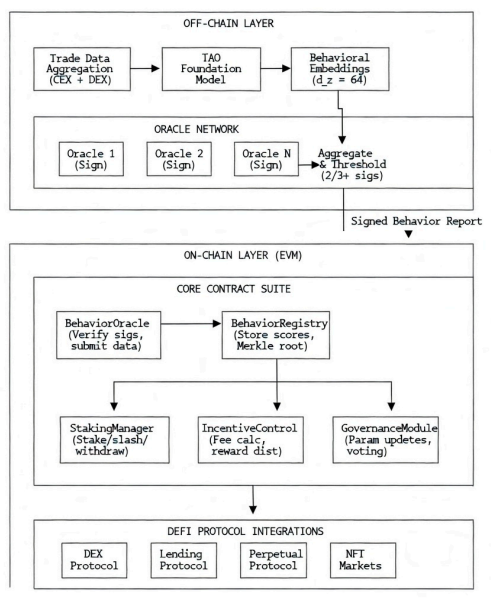 Off-chain TAQ inference → Oracle Network → On-chain Core Contract Suite → DeFi Protocol Integrations
4.2 Core Smart Contract Components
| Contract | Responsibility | Key Functions |
|---|---|---|
| BehaviorRegistry | Central storage for scores, weights, clusters | registerParticipant(), updateScore(), getScore() |
| BehaviorOracle | Receives & validates off-chain inference | submitBehaviorReport(), verifySignatures() |
| StakingManager | Staking, slashing, withdrawals | stake(), slash(), claimRewards() |
| BehaviorVerifier | Merkle proofs & score validity | verifyMerkleProof() |
| IncentiveController | Reward & fee calculations | calculateFee(), distributeEpochRewards() |
| GovernanceModule | Parameters, upgrades, voting | proposeUpdate(), vote() |
4.3 Core Interface Specifications (Solidity)
IBehaviorRegistry (excerpt)
// SPDX-License-Identifier: MIT
pragma solidity ^0.8.19;

interface IBehaviorRegistry {
    struct BehaviorScore {
        uint256 totalUtility;
        uint256 motivationScore;
        uint256 outcomeScore;
        uint256 weight;
        uint256 activeness;
        bytes32 clusterAssignment;
        uint256 lastUpdateEpoch;
        uint8 status; // 0=Pending ... 3=Slashed
    }

    event ScoreUpdated(address indexed participant, uint256 newTotalUtility, uint256 newWeight, bytes32 clusterAssignment, uint256 indexed epoch);
    // ... full interface continues in document
}
(Full interfaces for IBehaviorOracle, IStakingManager, IIncentiveController are defined in the specification with complete structs, events, and function signatures.)
4.4 Weight Update Implementation
function updateWeight(address validator, uint256 newUtility) internal {
    // RHO = 0.9 scaled by 1e18
    uint256 RHO = 9e17;
    uint256 ONE = 1e18;
    uint256 normalizedUtility = normalizeUtility(newUtility);
    uint256 oldComponent = ((ONE - RHO) * score.weight) / ONE;
    uint256 newComponent = (RHO * normalizedUtility) / ONE;
    score.weight = oldComponent + newComponent;
}
4.5–4.8 Slashing, Behavioral Fees, Gas Optimizations, and DeFi Integration Patterns
(Full code snippets and integration examples for DEX swaps and lending collateral ratios are provided "view more" document.)
5. ZK-Rollup Integration Architecture
5.1 ZK-Rollup Fundamentals for PoB
- Complex computation off-chain (full TAQ inference)
- Privacy-preserving verification
- Efficient batch processing (~200K gas per proof)
- Cryptographic integrity
5.2 System Architecture
ZK-Rollup PoB Integration Architecture
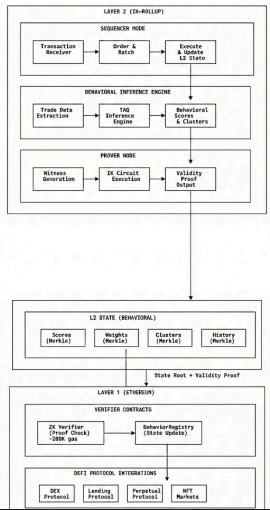
Layer 2 (Sequencer → Behavioral Inference Engine → Prover) → Layer 1 Verifier Contracts
5.3–5.6 ZK Circuit Design, Constraints, Pseudocode, Proof System Selection & L1 Verifier Contract
Recommended Hybrid Approach: Inner zk-STARK (complex inference) + Outer zk-SNARK (L1 verification).
ZKBehaviorVerifier Contract (excerpt)
contract ZKBehaviorVerifier {
    function processStateTransition(
        bytes calldata proof,
        bytes32 oldStateRoot,
        bytes32 newStateRoot,
        uint256 epoch,
        uint256 participantCount
    ) external { /* Groth16 verification + state update */ }
}